

Product News
Subwoofer Cardioid Design & Preset Guide(e.g., KA18_100_C)
Views : 4765
Update time : 2026-05-05 15:43:52
⇒ What is Cardioid (Heart-shaped) Pattern design?
In professional audio engineering, the Cardioid (Heart-shaped) Pattern design is a sophisticated method of controlling sound dispersion. It is primarily used to manage low-frequency energy, which is naturally omnidirectional.Here is a professional yet clear overview of its functions:
The "Shadow" Effect: Cardioid design creates a "Null Point" or cancellation zone behind the speaker.
Result: It reduces rear energy by 15dB to 25dB, creating a quiet stage environment for performers and preventing the "low-end roar" that muddies the mix.
Acoustic Isolation: Since microphones are typically positioned behind the front-of-house (FOH) speakers, the cardioid pattern keeps the mics inside the "quiet zone."
Result: This allows engineers to push microphone levels much higher without triggering feedback, which is critical for vocal clarity and high-energy live shows.
Controlling the "Bounce": By minimizing the energy sent toward the rear wall, you significantly reduce early reflections and standing waves.
Result: The bass becomes "Tighter" and more defined. It eliminates the "mushy" sound caused by phase interference between the direct sound and the reflected sound.
Efficient Coverage: Using techniques like Phase Cancellation and Delay Alignment, the energy is concentrated specifically on the audience area.
Result: Even in complex environments, you achieve a focused, punchy, and professional sound field.
The Setup: Some speakers face the audience, but one unit (or group) must be flipped to face the stage (away from the audience).
The Principle: This reversed speaker acts as an "inside agent." Its job is to emit a "reverse sound wave" that neutralizes the noise escaping from the back of the front-facing speakers.
Vertical Stacking: If three units are stacked (e.g., two front, one back), all speaker grilles must be perfectly aligned on the same vertical plane. Do not have some sticking out further than others.
Front-to-Back Placement: If speakers are placed one behind the other, the distance between their centers must strictly follow the manual (usually calculated based on the frequency you want to cancel, such as 0.8m or 1.2m).
The Mistake: Thinking that since there is no sound behind the speaker, you can push it right against the wall.
The Consequence: The cancellation process needs physical space for the sound waves to meet and neutralize. If it's against a wall, the waves bounce back before they can cancel out, causing the cardioid effect to fail and making the bass sound muddy.
The Rule: Leave at least 1 meter of clearance between the back of the speaker and any walls or obstacles.
The Reason: If you use four or five front units with only one rear unit, the "agent" won't have enough power to suppress the massive energy escaping to the back. The stage will remain noisy.
The Method: Stack three SB18s vertically.
Orientation: The bottom two face the audience; the top one is reversed (facing the stage).
Alignment (Critical): The front grilles of all three units must be in the same vertical plane. Do not shift the reversed unit backward; they must be aligned as precisely as a "cut of tofu."
The Key: Sinbosen factory presets are based on physical symmetry. The center line of the reversed cabinet must align perfectly with the center lines of the front-facing units.
Identifying the Preset: You need to look for presets labeled [KA18_C] or [KA18_60_C] (where "C" stands for Cardioid).
Without the correct processing on your controller (L-4X / L-8 / L-12X), this setup is just a noisy mess.
Preset Selection: In LA Network Manager or on the amp panel, you must load a preset with the [C] identifier (e.g., [KA18_100_C]).
Configuration Ratio: The typical ratio is 3:1 (three facing forward, one facing rear) or 2:1. The rear-facing cabinet must be connected to a dedicated amplifier channel loaded with this specific "C" preset.
Selection Guide:
Specifically, the presets are KA18 LFLFLFLF 60 C or KA18 LFLFLFLF 100 C.
For high-impact, punchy bass: Choose the 100 (100Hz) preset.
For deep, soft, and sub-heavy bass: Choose the 60 (60Hz) preset.
Special Reminder: When using presets with the “C” suffix, you must verify the physical wiring. Typically, in Cardioid mode, the last channel of the amplifier (e.g., Channel 4) is specifically reserved for that "rear-facing" cabinet.
Channel Routing:
Channels 1, 2, and 3 drive the front-facing units.
Channel 4 drives the reversed unit (the amp automatically applies the necessary delay and polarity inversion to Channel 4).
The Rule: Maintain at least 1 meter of clearance between the back of the array and the stage or rear wall. If placed too close to a wall, low-frequency reflections will destroy the cardioid cancellation effect.
Recommendation: Only consider this setup when you have at least 3 units per stack to ensure both high impact in the front and silence on the stage.
SPL mapping of a block of four KA18 in standard (left) and cardioid (right) arrangements, using surfaces of equal sound pressure with three dB step colored scale.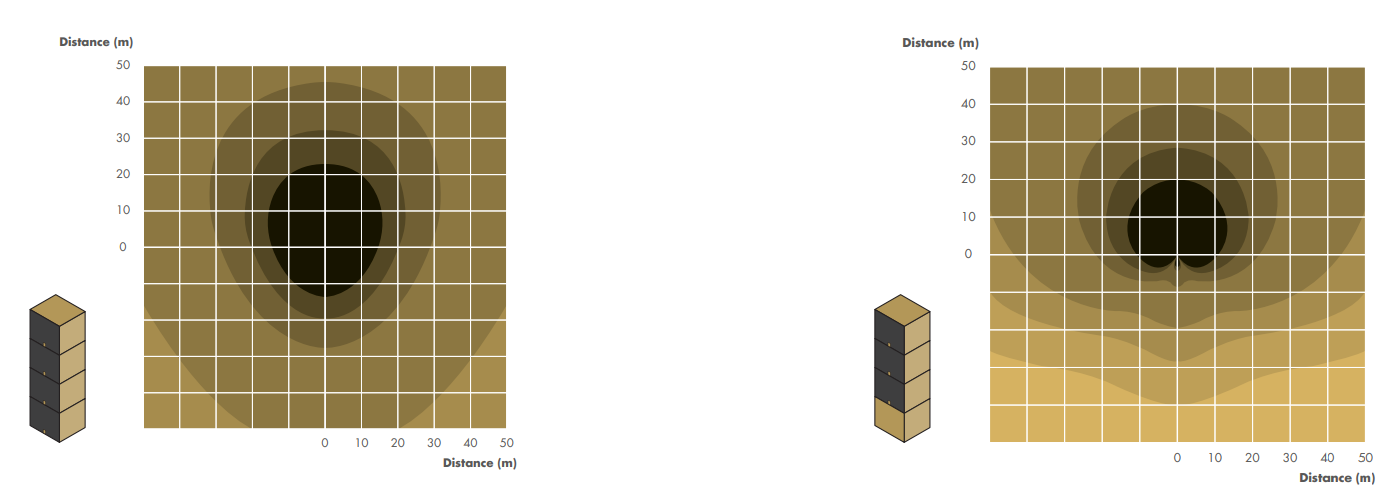
Group A: Integrated Cardioid
Models: YT-SUB / JT-SUB / VT-SUB / STL-SUB
Key Feature: Built-in cardioid design, saves time and labor.
Slogan: All Forward. Auto Rejection.
Group B: Cardioid Array
Models: KA21 / KA28 / KA18 / BN30
Key Feature: Traditional combination, high flexibility.
Slogan: Physical Array. Targeted Sound.
⇒ How to Read Speaker Presets? (Using KA18 as an Example)
Core Naming Logic
KA18 / KB28: Represents the corresponding speaker model.
LF: Stands for Low Frequency, indicating that the channel is responsible for subwoofer output.
60 / 100: Represents the Crossover Point (Cutoff Frequency), which determines the frequency range (in Hz) the subwoofer will handle.
C: Stands for Cardioid (Heart-shaped directivity).
CX / AB: Represents Combination Modes (e.g., paired with Kara line arrays).
Detailed Preset Analysis
⇒ Is cardioid directivity exclusive to subwoofers?
Not necessarily, but subwoofers need it the most. This is because the lower the frequency, the longer the wavelength, and the stronger its ability to diffract (wrap around objects). Standard subwoofers are omnidirectional (360° radiation), which causes massive amounts of energy to spill onto the stage, leading to low-frequency bleed into microphones or feedback. Cardioid technology became widely popular in the subwoofer domain specifically to solve this pain point.
STL-Series (KTS/GTS): These are among the few full-bandwidth directivity control line arrays in the industry. Not only the lows, but even the mid-range achieves cardioid directivity through side-vented cabinets and digital processing, ensuring the stage area remains exceptionally clean from low to high frequencies.
Studio Monitors: Some high-end studio monitors feature acoustic vents or flow channels on the sides of the cabinet. These use passive cancellation principles to achieve full-band cardioid directivity, reducing room boundary reflections and improving listening accuracy.
Cardioid Microphones: Although not speakers, cardioid technology's most widespread application in sound reinforcement is actually in microphones.
In professional audio engineering, the Cardioid (Heart-shaped) Pattern design is a sophisticated method of controlling sound dispersion. It is primarily used to manage low-frequency energy, which is naturally omnidirectional.Here is a professional yet clear overview of its functions:
1. Rear Rejection & Stage Silence
Standard subwoofers radiate sound in a 360-degree sphere, causing massive low-end buildup on stage.The "Shadow" Effect: Cardioid design creates a "Null Point" or cancellation zone behind the speaker.
Result: It reduces rear energy by 15dB to 25dB, creating a quiet stage environment for performers and preventing the "low-end roar" that muddies the mix.
2. Maximizing Gain Before Feedback (GBF)
Feedback occurs when a microphone picks up the output from a speaker and creates a loop.Acoustic Isolation: Since microphones are typically positioned behind the front-of-house (FOH) speakers, the cardioid pattern keeps the mics inside the "quiet zone."
Result: This allows engineers to push microphone levels much higher without triggering feedback, which is critical for vocal clarity and high-energy live shows.
3. Mitigating Room Interference & Reflections
Indoor venues often suffer from poor acoustics due to sound bouncing off the back wall.Controlling the "Bounce": By minimizing the energy sent toward the rear wall, you significantly reduce early reflections and standing waves.
Result: The bass becomes "Tighter" and more defined. It eliminates the "mushy" sound caused by phase interference between the direct sound and the reflected sound.
4. Precision Energy Steering
Instead of wasting power by blasting sound in every direction, cardioid technology "shapes" the acoustic wave.Efficient Coverage: Using techniques like Phase Cancellation and Delay Alignment, the energy is concentrated specifically on the audience area.
Result: Even in complex environments, you achieve a focused, punchy, and professional sound field.
Summary for Pro Use:
|
⇒ For this "acoustic battle" to be precise, here are the four most critical rules for Cardioid placement:
a.Direction: There Must Be an "Inside Agent"
A cardioid array requires at least two groups (or two units) of speakers.The Setup: Some speakers face the audience, but one unit (or group) must be flipped to face the stage (away from the audience).
The Principle: This reversed speaker acts as an "inside agent." Its job is to emit a "reverse sound wave" that neutralizes the noise escaping from the back of the front-facing speakers.
b. Distance: Centimeter-Level Alignment
Sound cancellation is extremely sensitive to timing. If the position is slightly off, the cancellation will turn into amplification.Vertical Stacking: If three units are stacked (e.g., two front, one back), all speaker grilles must be perfectly aligned on the same vertical plane. Do not have some sticking out further than others.
Front-to-Back Placement: If speakers are placed one behind the other, the distance between their centers must strictly follow the manual (usually calculated based on the frequency you want to cancel, such as 0.8m or 1.2m).
c. Space: Never Place Against a Wall
This is the most common mistake for beginners.The Mistake: Thinking that since there is no sound behind the speaker, you can push it right against the wall.
The Consequence: The cancellation process needs physical space for the sound waves to meet and neutralize. If it's against a wall, the waves bounce back before they can cancel out, causing the cardioid effect to fail and making the bass sound muddy.
The Rule: Leave at least 1 meter of clearance between the back of the speaker and any walls or obstacles.
d.Configuration: Energy Matching
The Ratio: A 2:1 ratio is generally recommended (two front-facing units for every one rear-facing unit).The Reason: If you use four or five front units with only one rear unit, the "agent" won't have enough power to suppress the massive energy escaping to the back. The stage will remain noisy.
|
Summary:
Flip one over: At least one speaker must face the stage. Align them perfectly: They must be aligned vertically like soldiers on guard; no shifting. Leave a gap: Don't stick the "butt" of the speaker against a wall; let the waves have room to "fight." Select the Preset: Once placed, you must select the Cardioid preset in the amplifier. Otherwise, it’s just a regular speaker facing the wrong way. |
⇒ How to achieve a perfect cardioid configuration for the KA18 SUB?
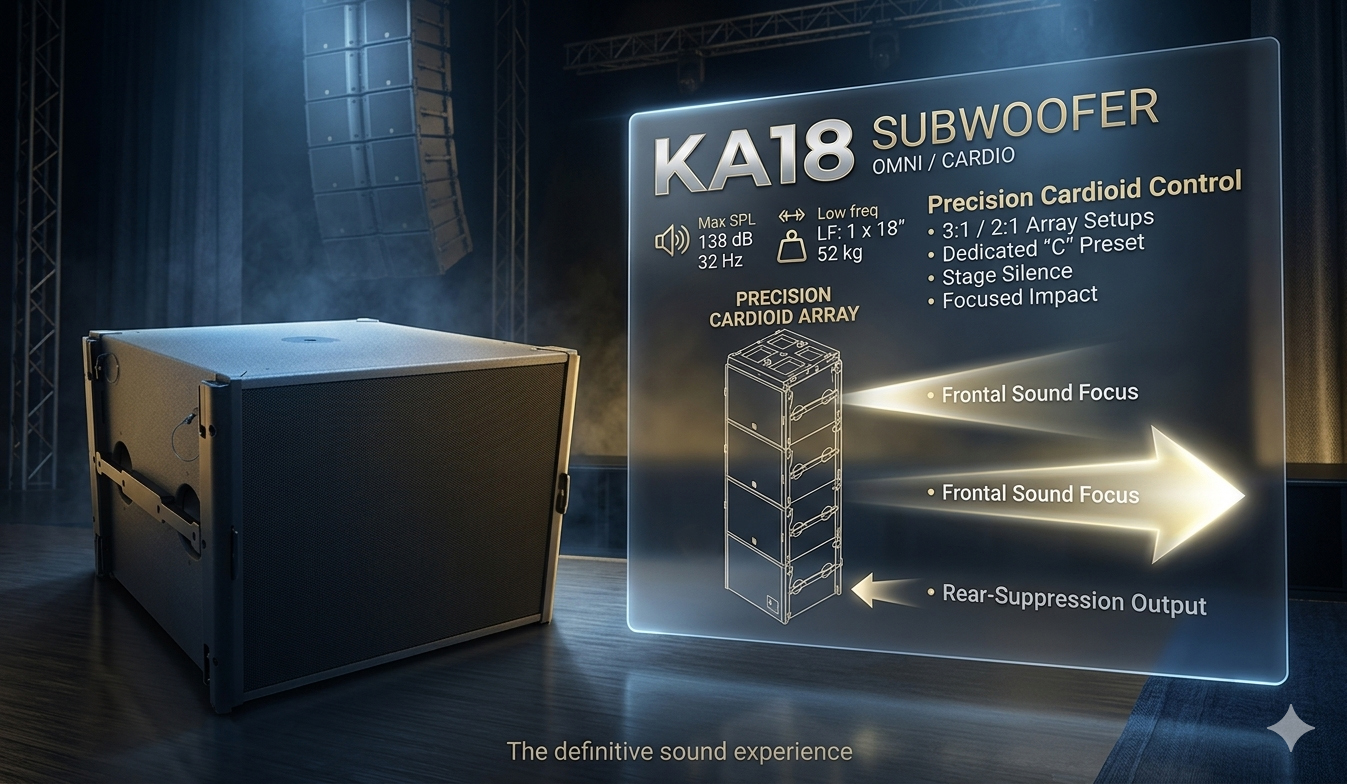
The most classic official setup is the "3-in-1" stack (3+1 or 2+1). This is formally known as the "Cardioid Configuration" in the ecosystem.
a. Physical Placement: The Classic "2+1" Stack
To effectively cancel rear energy, you need at least three SB18 units.The Method: Stack three SB18s vertically.
Orientation: The bottom two face the audience; the top one is reversed (facing the stage).
Alignment (Critical): The front grilles of all three units must be in the same vertical plane. Do not shift the reversed unit backward; they must be aligned as precisely as a "cut of tofu."
b. The "Pitfall": Cabinet Symmetry
When the KA18 is reversed, its connection panel will face the audience.The Key: Sinbosen factory presets are based on physical symmetry. The center line of the reversed cabinet must align perfectly with the center lines of the front-facing units.
c. Amplifier Presets: Selecting [KA18_C]
In the L-12X preset library, ready-to-use presets are available.Identifying the Preset: You need to look for presets labeled [KA18_C] or [KA18_60_C] (where "C" stands for Cardioid).
Without the correct processing on your controller (L-4X / L-8 / L-12X), this setup is just a noisy mess.
Preset Selection: In LA Network Manager or on the amp panel, you must load a preset with the [C] identifier (e.g., [KA18_100_C]).
Configuration Ratio: The typical ratio is 3:1 (three facing forward, one facing rear) or 2:1. The rear-facing cabinet must be connected to a dedicated amplifier channel loaded with this specific "C" preset.
Selection Guide:
Specifically, the presets are KA18 LFLFLFLF 60 C or KA18 LFLFLFLF 100 C.
For high-impact, punchy bass: Choose the 100 (100Hz) preset.
For deep, soft, and sub-heavy bass: Choose the 60 (60Hz) preset.
Special Reminder: When using presets with the “C” suffix, you must verify the physical wiring. Typically, in Cardioid mode, the last channel of the amplifier (e.g., Channel 4) is specifically reserved for that "rear-facing" cabinet.
Channel Routing:
Channels 1, 2, and 3 drive the front-facing units.
Channel 4 drives the reversed unit (the amp automatically applies the necessary delay and polarity inversion to Channel 4).
d. Boundary Distance: Leave "Breathing Room"
The KA18 features large laminar vents (ports).The Rule: Maintain at least 1 meter of clearance between the back of the array and the stage or rear wall. If placed too close to a wall, low-frequency reflections will destroy the cardioid cancellation effect.
e. When NOT to Use Cardioid?
If you only have two SB18s (one per side), a cardioid setup is usually not recommended. Using one as a "rejection" unit would result in too much loss of forward energy (SPL) for the audience.Recommendation: Only consider this setup when you have at least 3 units per stack to ensure both high impact in the front and silence on the stage.
Summary of KA18 Operation:
|
SPL mapping of a block of four KA18 in standard (left) and cardioid (right) arrangements, using surfaces of equal sound pressure with three dB step colored scale.
⇒ Sinbosen Cardioid Speaker Models:
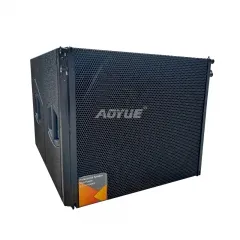
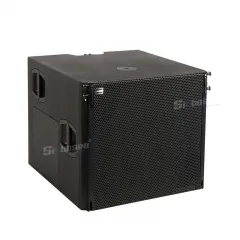
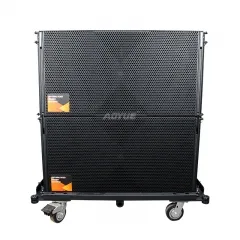
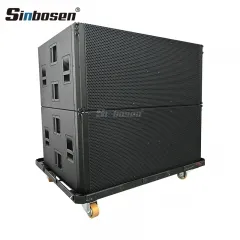
Group A: Integrated Cardioid
(No rear-facing needed, all forward)
Models: YT-SUB / JT-SUB / VT-SUB / STL-SUB Key Feature: Built-in cardioid design, saves time and labor.
Slogan: All Forward. Auto Rejection.
 |
 |
 |
 |
| YT-SUB | VT-SUB | JT-SUB | STL-SUB |
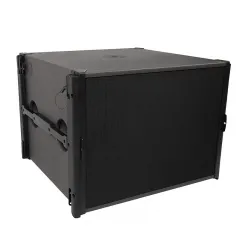
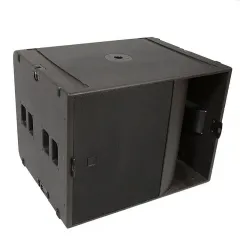
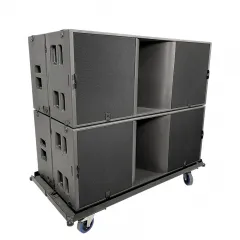
Group B: Cardioid Array
(Manual setup, front & back)
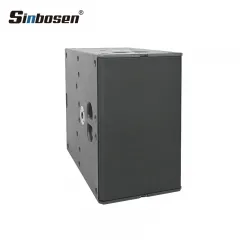
Models: KA21 / KA28 / KA18 / BN30Key Feature: Traditional combination, high flexibility.
Slogan: Physical Array. Targeted Sound.
 |
 |
 |
 |
| KA18 | KA21 | KA28 | BN30 |
⇒ How to Read Speaker Presets? (Using KA18 as an Example)
Core Naming Logic
KA18 / KB28: Represents the corresponding speaker model.
LF: Stands for Low Frequency, indicating that the channel is responsible for subwoofer output.
60 / 100: Represents the Crossover Point (Cutoff Frequency), which determines the frequency range (in Hz) the subwoofer will handle.
C: Stands for Cardioid (Heart-shaped directivity).
CX / AB: Represents Combination Modes (e.g., paired with Kara line arrays).
Detailed Preset Analysis
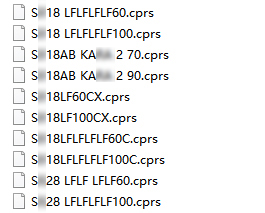
| Preset Name | Detailed Meaning & Analysis |
| KA18 LFLFLFLF 60 | Standard Mode. All four channels (LFLFLFLF) are set for forward output with a 60Hz cutoff. Best for scenarios requiring extreme low-end extension without needing high-frequency crossover overlap. |
| KA18 LFLFLFLF 100 | Standard Mode. All four channels are forward output with a 100Hz cutoff. This is the most common mode, ideal for pairing with small-to-medium line arrays. |
| KA18AB KA208 2 70/90 | Combination Preset. Designed for KA18 used in conjunction with Kara line arrays. The "2" likely refers to the quantity ratio, while "70/90" typically refers to the vertical coverage angles or specific crossover settings of the KA208. |
| KA18LF 60 CX | Hybrid or Single Channel Mode. "CX" usually stands for Custom or Cross mode, likely a 60Hz preset customized for specific engineering environments. |
| KA18LF 100 CX | Same as above, but with a 100Hz cutoff frequency. |
| KA18 LFLFLFLF 60 C | Cardioid Mode (60Hz). The "C" at the end is critical—this is the Cardioid preset you asked about. Once loaded, the amplifier automatically configures the delay and phase to achieve rear-cancellation. |
| KA18 LFLFLFLF 100 C | Cardioid Mode (100Hz). Also a Cardioid mode, but allows the subwoofers to handle frequencies up to 100Hz, suitable for tighter, punchier system setups. |
| KB28 LFLFLFLF 60/100 | Standard presets for the SB28 (dual 18-inch subwoofer), corresponding to 60Hz and 100Hz crossover points respectively. |
⇒ Is cardioid directivity exclusive to subwoofers?
Not necessarily, but subwoofers need it the most. This is because the lower the frequency, the longer the wavelength, and the stronger its ability to diffract (wrap around objects). Standard subwoofers are omnidirectional (360° radiation), which causes massive amounts of energy to spill onto the stage, leading to low-frequency bleed into microphones or feedback. Cardioid technology became widely popular in the subwoofer domain specifically to solve this pain point.
Other Cardioid Speakers and Devices:
Cardioid Line Arrays (Mid-High Frequencies): In reality, the mid-to-high frequency units of most high-end line arrays already possess a degree of directivity, though this is primarily controlled through horns.STL-Series (KTS/GTS): These are among the few full-bandwidth directivity control line arrays in the industry. Not only the lows, but even the mid-range achieves cardioid directivity through side-vented cabinets and digital processing, ensuring the stage area remains exceptionally clean from low to high frequencies.
Studio Monitors: Some high-end studio monitors feature acoustic vents or flow channels on the sides of the cabinet. These use passive cancellation principles to achieve full-band cardioid directivity, reducing room boundary reflections and improving listening accuracy.
Cardioid Microphones: Although not speakers, cardioid technology's most widespread application in sound reinforcement is actually in microphones.
Contact us:
 sales2@sinbosen.com
Whatsapp:https://api.whatsapp.com/send?l=en&phnoe=8616676738225
Website:https://www.sinbosenaudio.com/

