

Product News
The Difference V-7 and V-10 Point source loudspeakers?
Views : 12086
Update time : 2025-12-31 17:23:50
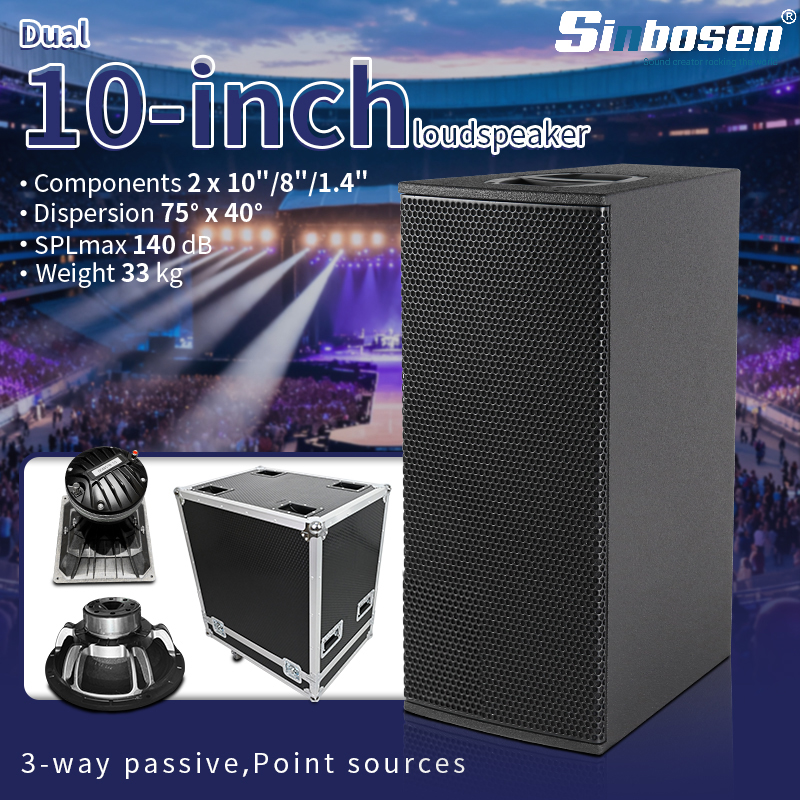 |
The 3-way passive V-7 point source loudspeakers produce a constant directivity dispersion of 75° x 40° (h x v) with exceptional vertical constant directivity dispersion control nominally being maintained down to 350 Hz. This is achieved using a symmetrical dipolar driver arrangement for the two 10" LF neodymium drivers, with a centrally mounted horn-loaded 8" MF driver and a coaxial 1.4" exit HF compression driver mounted on a constant directivity horn.
The V-10 point source loudspeakers feature the same driver configuration, but produce a wider 110°horizontal dispersion pattern. Both loudspeakers feature a rotatable HF horn which enables deployment in either orientation. The advanced bass reflex and venting design combined with a large cabinet volume increases the LF performance of these compact cabinets, with a frequency response extending from 59 Hz to 18 kHz V-7: 75° narrow throw—long FOH, side-fill, delay tower. V-10: 110° wide spread—short front-fill, under-balcony, wide-area fill. |
| On the outside the V-7 and V-10 look absolutely identical: a slim cabinet measuring 700 × 308 × 466 mm (H×W×D) and weighing 33 kg – a weight that already hints at the high density inside. Despite the consistent use of neodymium drivers, the large horn assemblies, the numerous multiplex-wood parts and the components of the passive crossover all add up. Remove the front grille and the complex internal layout becomes visible. All three ways share a common centre axis, with the high-frequency horn positioned in the centre. The HF horn is supplied in two versions: 110° × 40° for the V-10 and 75° × 40° for the V-7; both are rotatable. After taking off the grille only four screws that hold the horn have to be undone. Even with the grille in place the installed horn can be identified by white marks on its edges. Behind the compression driver sits the 8" mid-bass unit, its rear carrying a small aluminium heatsink whose fins improve cooling, while its front feeds a compression chamber that opens into the divided horn. Viewed from the side the advantage over the usual horn-in-horn layout is obvious: the tweeter no longer acts as a reflective obstacle inside the mid horn. What remains is the unavoidable diffraction of sound at the mouths where the two horns meet. The two 10" bass drivers are mounted inside the enclosure and radiate through two band-pass chambers. The ports of the small chambers in front of the cones sit right at the outer edges of the cabinet; the large chamber vents through slots on the mid-horn surface. The result is extremely high packing density, giving the additional benefit that all acoustic sources lie very close together. |
 |
Contact us:
 sales2@sinbosen.com
Whatsapp:https://api.whatsapp.com/send?l=en&phnoe=8616676738225
Website:https://www.sinbosenaudio.com/

