

Product News
Sinbosen Point-Source Speaker Recommendations
Views : 7012
Update time : 2026-06-01 18:14:49
» What is a Point Source Speaker?
A Point Source Speaker is one of the most classic and common design concepts in audio systems.Simply put, a point source speaker refers to a loudspeaker where the sound appears to radiate outward in a fan-shaped pattern from a "single geometric point." In an ideal state, no matter how many tweeters, mid-range drivers, or woofers are inside, the sound emitted by these components blends perfectly in perception. It sounds as though it originates from a single point and propagates outward in the form of a spherical waveform.
» Core Characteristics of Point Source Speakers
1. Spherical Waveform Propagation
The sound dispersion of a point source speaker resembles a constantly expanding balloon. It typically features a relatively wide coverage angle (e.g., 90° horizontal,60°vertical), which means it provides an exceptionally broad coverage area directly in front of the speaker and in the near-field zone.2. Distance Attenuation: The -6dB Rule
This is the most prominent physical characteristic of a point source speaker. According to the Inverse Square Law:Every time the distance from the speaker doubles, the Sound Pressure Level (SPL) drops by 6dB.
At 1 meter: 100 dB
At 2 meters: 94dB(drops by 6dB)
At 4 meters: 88dB(drops by another 6dB)
At 8 meters: 82dB(drops by another 6dB)
Consequently, point source speakers have a relatively short throw (range). If a venue is very deep, the audience in the back rows will hear a much lower volume compared to those in the front.
» Common Configurations of Point Source Speakers
To achieve the "sound originating from a single point" effect, manufacturers typically employ the following design approaches: |
 |
| Dipolar Symmetrical Configuration This approach positions the mid-high frequency horn at the absolute center of the enclosure, flanked symmetrically—either vertically or horizontally—by the low-frequency woofers. This physical arrangement forces the acoustic centers of all frequency bands to align closely at the exact same spatial coordinate. |
Coaxial Technology This method embeds the high-frequency compression driver directly along the central axis of the low-frequency woofer. By sharing a single acoustic axis, the components achieve complete phase and time alignment, representing the theoretical ideal of point source wave propagation. |
» Point Source vs. Line Array Speakers
| Characteristic | Point Source Speaker | Line Array Speaker |
| Waveform Shape | Spherical Wave (disperses outward like an expanding balloon) | Cylindrical Wave (disperses outward like a widening cylinder) |
| Distance Attenuation | Drops by 6dB per doubling of distance (rapid decay) | Drops by 3dB per doubling of distance (slower decay within the coverage zone) |
| Acoustic Imaging | Excellent; provides exceptionally clear, natural stereo imaging and localization | Optimized primarily for SPL coverage; spatial localization is less precise than a point source |
| Applications | Small-scale gigs, banquet halls, clubs/bars, private home theaters, stage monitors | Large stadiums, massive electronic music festivals, major outdoor music festivals |
| Visual Footprint | Compact and flexible installation; rarely obstructs sightlines | Requires multi-cabinet flying (hanging grids); bulky footprint with high visual impact |
» Best Application Scenarios for Point Source Speakers
Although line arrays have become the go-to standard for mid-to-large-scale concerts, point source speakers remain the "irreplaceable king" in the following scenarios:High-End Private Home Theaters & Multi-Purpose Halls
Because the listening distance is short, these environments demand an exceptional sense of sonic envelopment and razor-sharp vocal/dialogue localization.Stage Monitoring
Musicians and vocalists stand incredibly close to the monitors. Coaxial point source wedges deliver the cleanest, most immediate direct sound with zero phase interference.Small-to-Medium Conference Rooms & Live Houses
Their wide dispersion ensures that a large portion of the venue achieves uniform coverage and a consistent listening experience within a relatively short distance.Outdoor Fill Speakers
When a massive line array cannot cover blind spots in the front rows (Front Fills) or extreme sides (Side Fills), sound engineers typically deploy a few high-output point source cabinets to provide precision acoustic reinforcement.» Why are some speakers advertised as both Point Source and Line Array?
In the professional audio industry, loudspeakers that claim to be "both a point source and a line array" are typically referred to as Modular Line Sources, Constant Curvature Line Arrays, or what manufacturers often call "Flexible Source" speakers.The reason they can embody the characteristics of both systems comes down to clever engineering that manipulates physical boundaries and configurations. Put simply: when used as a single cabinet, it functions as a high-quality point source speaker; however, when multiple cabinets are stacked or flown together, they acoustically couple to become a line array.
The core secrets behind this identity-shifting capability include the following points:
1. The Core Secret: Waveguide Design for Coherent Coupling
In traditional point source speakers, the high-frequency horn has a wide vertical dispersion angle (e.g., 60°). If you simply stack or rig two traditional cabinets tightly together, their high-frequency acoustic waves will fight each other, creating severe comb filtering distortion.Loudspeakers with a "dual identity" overcome this challenge by utilizing a precision-engineered high-frequency waveguide (such as DOSC waveguide technology or highly specialized coaxial waveguides):
When used individually: The vertical dispersion angle is strictly constrained to a very narrow, precise window (typically between 15° and 30°). Because the vertical coverage of a single cabinet is so tight, it behaves as a highly directional point source.
When arrayed together: When you couple two or more cabinets tightly together, their high-frequency exits align within a fraction of a wavelength. This alignment allows them to achieve true physical waveform coupling. At this point, the individual spherical waves merge vertically into a single, continuous cylindrical wavefront, instantly inheriting the line array characteristic of dropping only 3dB per doubling of distance.
2.Why is this "Dual Identity" design needed?
This design perfectly bridges the "gray area" between traditional point sources and large-scale line arrays, delivering immense commercial and engineering value:
Fixed Angles, Saving Time and Labor
Setting up a traditional large-scale line array (such as a system for a 20,000-person music festival) requires system engineers to use software to precisely calculate the inter-cabinet splay angles between every single enclosure (e.g., 1°, 2°, 3.5°).
In contrast, these hybrid "point source/line array" systems typically feature a Constant Curvature design. The physical trapezoidal angle of the speaker enclosure determines its fixed coverage angle (e.g., 15° vertically per cabinet).
Fly 1 cabinet: Covers 15°
Array 3 cabinets vertically: Flawless physical alignment, seamlessly covering exactly 45°
This eliminates the need for complex angle adjustments on-site. Once the rigging hardware locks into place, a mathematically perfect line array coverage pattern is instantly formed.
Flexible Modular Application (Unmatched Versatility)
For rental companies and AV integrators, these speakers act as true "transformers" in their inventory:
Scenario A: A High-End Wedding or Corporate Launch: The venue is compact, and rigging weight limits are strict. By simply pole-mounting a single cabinet or ground-stacking a full-range enclosure on each side of the stage, it functions as a pristine point source speaker with crystal-clear audio and precise localization.
Scenario B: A Medium-Sized Gymnasium Auditorium or Live House: The venue features a deep audience area requiring a long throw. By rigging and flying 3-4 cabinets in a vertical column, the system instantly transforms into a coherent line array, effortlessly throwing consistent sound coverage all the way to the back rows.
3. Iconic Industry Examples
Many of the most popular, blockbuster speaker systems you see in the industry today actually feature this dual-identity hybrid design:
•KA10 / KA15: The manufacturer officially classifies these as "Medium Throw Line Sources." However, when used as a standalone cabinet—especially when utilizing their adjustable Panflex horizontal directivity vanes—they function perfectly as top-tier, high-output point source fill speakers.
•CIVA (Active Collinear Source): This system features six medium-frequency drivers arranged in a strict vertical column inside the enclosure, leveraging line array collinear physics internally. Yet, the entire system is deployed and delivered as an elegant, plug-and-play single point source solution.
•V932: A legendary, industry-standard constant curvature "compact line array." Because a single cabinet provides a relatively wide vertical coverage of 15°, it is incredibly common to see production crews tripod-mounting a single V932 as a point source box in smaller venues. Meanwhile, in medium-sized venues, they fly 3-4 units in a cluster to act as a proper line array.
Summary
To put it simply, these speakers are "point sources when fighting solo, and line arrays when charging in formation." Through precision-engineered acoustic waveguides, they shatter the rigid boundary between traditional speaker designs—allowing a single hardware inventory to deliver the razor-sharp clarity of a point source alongside the long-throw projection of a line array.
» Why Coaxial Speakers are the "Ultimate Point Source"
Earlier, we defined a point source speaker as a system where the sound appears to radiate from a "single geometric point."Conventional Point Source Speakers (Non-Coaxial): Take traditional models like the Martin Audio F15+ or JBL SRX715 as examples. In these designs, the high-frequency (HF) horn sits on top while the low-frequency (LF) woofer sits below. Even though they are positioned as close together as possible, they still occupy separate spaces. If you stand too close to the enclosure (e.g., within 1 meter), your ears can easily detect the physical displacement—you will perceive the highs coming from above and the lows coming from below.
Coaxial Point Source Speakers: Consider the MT-04 or XT-12. For these systems, loudspeaker designers mount the high-frequency driver directly along the exact center axis of the low-frequency driver. The high and low frequency sources physically overlap at the exact same spatial coordinate.
The Physical Advantage of Coaxial Design
Because the drivers share the same acoustic axis, the distance and arrival times for both high and low frequencies to reach your ears are absolutely identical—regardless of whether you are standing to the left, right, above, or below the cabinet. This total physical convergence achieves a true "single-point source radiation," delivering a level of flawless phase coherence that conventional, non-coaxial point source speakers simply cannot replicate.» Then why are coaxial speakers rarely used as "Long-Throw Main PAs"?
If coaxial speakers are so acoustically perfect, why aren't stadium main PA systems built entirely out of them?The reason stems from an inherent physical limitation unique to coaxial architecture: when the low-frequency (LF) cone vibrates violently, it essentially becomes a "dynamic physical boundary" for the high-frequency (HF) horn, which triggers severe high-frequency intermodulation distortion.
In near-field monitoring applications: The speaker is rarely pushed to its extreme Sound Pressure Levels (SPL). Because the cone movement remains minimal, this side effect is practically negligible.
In high-power, long-throw main PA applications: The LF woofers must undergo massive, aggressive piston movement (excursion) to throw sound across great distances. This violent movement severely disrupts the HF wave propagation pattern, causing the high frequencies to modulate unnaturally and making the overall sound signature muddy or "dirty."
The Industry Consensus
As a result, the pro-audio industry has reached a mutual understanding: harness the strengths of coaxial design where it shines brightest—allowing it to dominate the "near-field, high-precision" stage monitoring and premium fills domain. Meanwhile, the heavy lifting of long-distance acoustic projection is left to large-scale line arrays and dipolar point source systems.» SINBOSEN'S Point Source Speakers
1.LA SERIES
Pure Point Source Speakers (4 Models Total)
These four models belong to the X Series and exclusively feature high-end coaxial technology. Because the high-frequency and low-frequency drivers share the exact same acoustic axis, a single cabinet radiates sound flawlessly from a single geometric point, making them standard, pure point source loudspeakers. |
•XT-05An ultra-compact point source speaker, commonly deployed in premium fixed installations, discreet front fills, or television broadcast studios.
•XT-08The classic 8-inch point source. Known for its exceptionally pristine and detailed sonic signature, it is a staple for high-quality monitoring, main PA duties in intimate spaces, or stage-lip front fills.
•XT-12A highly versatile 12-inch point source. It serves as the definitive industry benchmark for short-throw stage monitoring (wedges) and excels as the main PA for small-to-medium-sized venues.
•XT-15 HiQThe 15-inch flagship point source. Specifically engineered for demanding, high-performance stage monitoring applications, it delivers robust low-frequency extension and massive Sound Pressure Level (SPL) capabilities.
|
Modular Line Arrays with a "Dual Identity" (1 Model Line)
•KA10 (Focus / Wide) & KA15 (Focus / Wide). Officially classified as Constant Curvature Line Sources.Why do they possess "Point Source Attributes"?
The reason they can seamlessly step into the role of a "high-output point source" lies in their highly unique vertical coverage design:
Focus Models: Feature a narrow 10°vertical dispersion angle (designed for longer throw and more concentrated energy).
Wide Models: Feature an impressive 30° vertical dispersion angle (designed for shorter throw but massive single-cabinet coverage).
In high-end weddings, corporate annual galas, or premium private parties, the venue depth rarely requires a massive line array system. Instead, the priorities are pristine sound quality and rapid setup times. System engineers will frequently use a simple speaker pole (pole-mount) to support just a single KA10 Wide or KA15 Wide directly over a subwoofer.
In this configuration, a single enclosure delivers an incredibly generous coverage pattern of 110° horizontally (which can be further tailored via Panflex technology) by 30° vertically. Without needing to array multiple cabinets together or calculate splay angles in acoustic software, the overall user experience and coverage characteristics are identically that of a top-tier, high-output point source speaker.
Transforming into a Line Array
When you encounter larger venues—such as medium-sized gymnasiums or mid-scale outdoor events—that demand a significantly longer throw and higher energy output, there is no need to switch to a different sound system.
You can simply rig and fly 2 to 4 units of A10 or A15 cabinets together (for example, stacking 1 Focus unit to handle the far-field paired with 2 Wide units to cover the near-field). The moment they are physically coupled, their high-frequency waveguides immediately achieve acoustic coherence, seamlessly transforming the setup into a standard, high-SPL constant curvature line array.
2.DB-SERIES Point Source Speakers
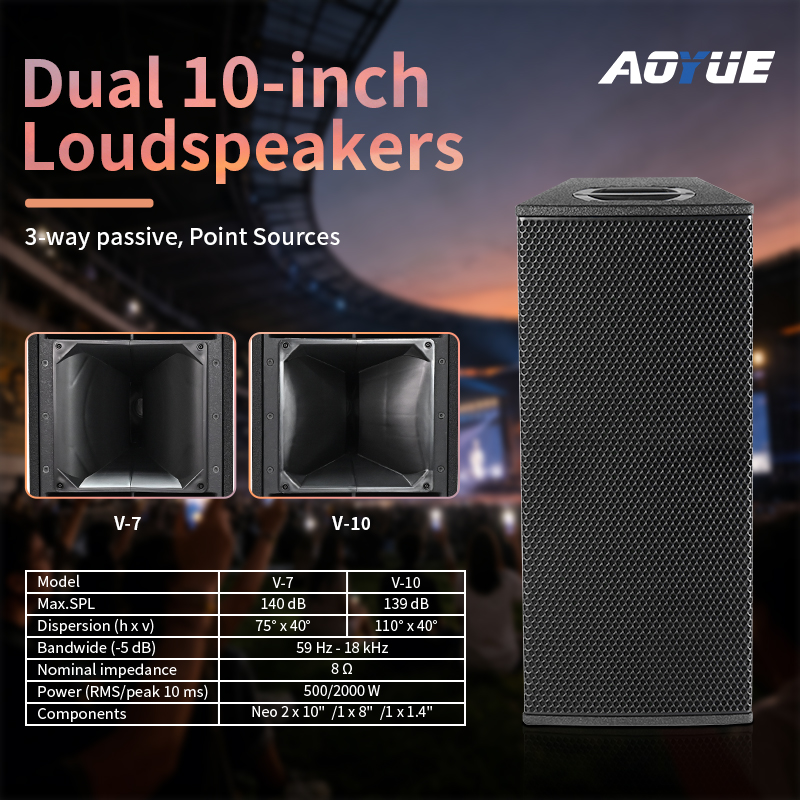
•V-7 / V-10 (Dual 10-inch, 3-Way Point Source)
Core Architecture: Housed within these cabinets are two 10-inch low-frequency (LF) drivers, one horn-loaded 8-inch mid-frequency (MF) driver, and a 1.4-inch exit high-frequency (HF) compression driver.
Point Source Identity: These enclosures utilize a dipolar driver arrangement. This configuration ensures that despite being a substantial 3-way loudspeaker, its acoustic centers remain highly centralized, allowing sound to radiate uniformly from a single focal point.
The Difference Between V-7 & V-10: The variance lies strictly in their dispersion patterns. The V-7 offers a 75°x 40°pattern (designed for a slightly longer throw), while the V-10 features a 110°x 40° pattern (offering wider horizontal coverage).
• Y-7 / Y-10 (Dual 8-inch, 2-Way Point Source)
Core Architecture: The internal layout consists of two 8-inch LF drivers and a 1.4-inch exit HF compression driver, also configured in a dipolar arrangement.
Point Source Identity: Compared to the V-Series, the Y-P Series features a lighter, more compact footprint. It serves as the absolute workhorse point source for mid-to-small-sized Live Houses, premium multi-purpose halls, and theater fill applications (Side-fills / Out-fills).
The Difference Between Y-7 & Y-10: The Y-7 delivers a 75°x 40° dispersion pattern, whereas the Y-10 provides a 110°x 40° coverage pattern.
Tech Tip: The HF constant-directivity horns in all four of the aforementioned point source models support a 90° rotation. If you need to deploy the cabinet in a horizontal orientation, simply remove the front grille and rotate the horn. This ensures your intended horizontal and vertical dispersion characteristics remain perfectly intact.
•MT-04 (The Industry-Legend Coaxial Point Source Monitor)
Core Architecture: The MT-04 is a high-performance, 2-way coaxial stage monitor wedge incorporating a 15-inch LF driver and a 1.3-inch exit HF compression driver.
Point Source Identity: Regarded globally as one of the finest stage reference monitors ever built, its coaxial architecture ensures that the acoustic centers of both the high and low frequencies completely overlap.
Performance Advantages: Vocalists and musicians usually stand incredibly close to their monitors on stage (typically 1 to 2 meters). This coaxial point source design guarantees that even if a performer moves laterally across the stage, the phase relationship between the high and low frequencies remains perfectly coherent. This eliminates acoustic detachment and dramatically reduces the risk of localized microphonic feedback (howling). It features a precise 50°x70° dispersion pattern.
3.JL-Series Point Source Speakers
•S715 — The Industry Benchmark for Traditional Point Source
Physical Architecture: A timeless, classic 15-inch, 2-way passive loudspeaker incorporating a 15-inch low-frequency (LF) woofer and a 3-inch high-frequency (HF) compression driver.Point Source Identity: This model represents the most standard, orthodox execution of a traditional point source speaker. The woofer and acoustic horn are positioned closely together, forcing the sound to project outward as a spherical wavefront from a single geometric source. It features a standard dispersion pattern of 75°x 50°.
Industry Status: It remains a legendary workhorse, serving as the definitive go-to standard for weddings, small-to-medium roadshows, and bar stages.
•V915M — Professional Coaxial/Point Source Stage Monitor
Physical Architecture: A dedicated 15-inch, 2-way stage monitoring wedge.Point Source Identity: Operating as a standard point source system, it features a low-profile, angled enclosure engineered explicitly for floor placement on stage. Because performers stand incredibly close to the speaker, its tightly integrated acoustic architecture delivers a singular point-source emanation. It provides a specialized 50°x90° dispersion pattern (narrow horizontally, wide vertically) tailored perfectly to cover the ear height of a standing vocalist.
•KP615 — Premium Point Source Tailored for KTV and Entertainment
Physical Architecture: A high-output, 15-inch, 2-way point source loudspeaker for high-end entertainment venues and premium KTV clubs.Point Source Identity: Engineered as a pure, entertainment-focused point source cabinet, its primary goal is to deliver uniform vocal and music distribution into every corner of a private room. To achieve this, it utilizes a wide-dispersion constant directivity horn offering a generous 70°x 100° coverage pattern.
4.Other Notable Models
•TN24 — The Definitive Dual 12-inch, 3-Way Point Source.The TN24 is an industry-standard, dual 12-inch, 3-way point source loudspeaker featuring a coaxial mid-high frequency section.
Core Acoustic Architecture (Why is it a pure point source?)
Removing the front grille of the TN24 reveals a masterfully engineered physical layout:It houses two 12-inch neodymium low-frequency (LF) drivers.
Positioned directly between these two woofers—at the absolute acoustic center of the cabinet—is a coaxial mid-high horn assembly, which combines a 1.4-inch exit high-frequency (HF) driver and a 3-inch mid-frequency (MF) cone driver.
This layout, which nests the coaxial mid-high elements dead center between symmetrically opposed woofers, is acoustically classified as a dipolar symmetrical configuration. It forces the physical acoustic centers of all frequency bands to completely align at the exact same spatial coordinate. As a result, the acoustic energy projects as a 100% coherent spherical waveform, yielding textbook-perfect phase alignment and razor-sharp vocal intelligibility.
Rotatable and Interchangeable Horns
Befitting its status as a flagship point source box, the TN24 features an incredibly versatile horn design. The manufacturer offers two distinct horn variants, both of which support a 90° rotation:Standard Configuration: A 60°x 40° horn (designed for maximum energy concentration and long-throw performance).
Wide-Dispersion Configuration: A 90°x 50° horn (optimized for wider, shallower audience footprints).
System engineers can easily remove the front grille and rotate the horn at any time based on whether the cabinet is being flown horizontally or vertically, guaranteeing that the intended dispersion angles are perfectly maintained.
•F12+ (12-inch, 2-Way Point Source)
Physical Architecture: The internal layout consists of a 12-inch low-frequency (LF) driver and a 1-inch exit high-frequency (HF) compression driver.Point Source Identity: Delivers standard spherical waveform projection with an official nominal dispersion pattern of $80^\circ \times 50^\circ$. It provides highly defined acoustic localization and excellent transient impact over short-to-medium distances, making it a staple for compact main PA setups, corporate conferences, or stage monitoring fills.
•F15+ (15-inch, 2-Way Point Source)
Physical Architecture: Housed within the cabinet is a high-power 15-inch neodymium LF woofer paired with a larger 1.4-inch exit HF compression driver.Point Source Identity: Shares the same 80° x 50° dispersion characteristics as its smaller sibling. Thanks to the upgraded 15-inch woofer and larger compression driver, it delivers deeper low-frequency extension and significantly higher Sound Pressure Level (SPL) capabilities. For years, it served as an absolute workhorse full-range main PA point source for wall-mount installations in live music bars, dance clubs, and small-to-medium mobile roadshows.
Iconic Engineering Feature: Rotatable HF Horn
Both the F12+ and F15+ models incorporate one of Martin Audio's signature engineering designs—a user-adjustable, 90° rotatable horn.If an installation requires the loudspeaker to be flown horizontally tucked tight against a ceiling, a system technician simply needs to remove the front grille and rotate the internal horn assembly. This instantly flips the dispersion pattern from 80°x 50° to 50°x 80°, ensuring that the wider coverage angle remains dedicated to the horizontal plane. This feature has become a hallmark requirement for premium point source loudspeakers.
•VR15 — High-Output Entertainment Point Source
Physical Architecture: Engineered with a 15-inch low-frequency (LF) woofer and a 1-inch exit (1.7-inch voice coil) high-frequency (HF) compression driver.Point Source Identity: Features a nominal dispersion pattern of 80°x 50°. True to premium point source design, the constant directivity horn can also be rotated 90°.
Design Philosophy: This point source system is meticulously voiced and tuned for live vocal performance (such as premium KTV private rooms and live music lounges). It delivers a rich, full-bodied mid-range for vocals and uniform acoustic distribution, providing an exceptionally cohesive and focused point source listening experience within a single-cabinet coverage zone or targeted stage area.
» Recommended Models: V-7 and TN24
 |
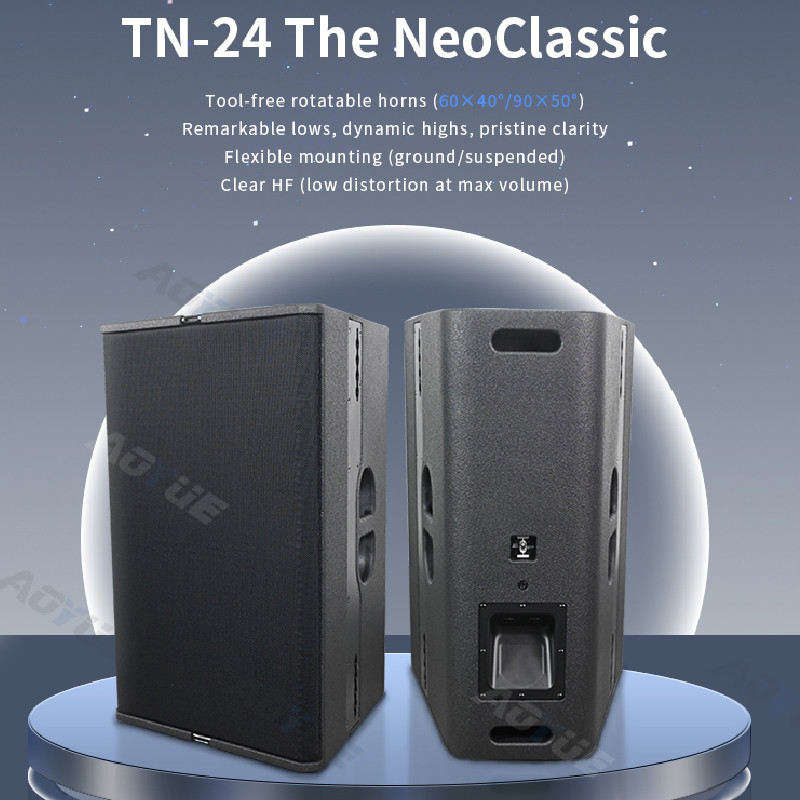 |
These two models are currently highly sought after and have quickly become some of our most requested loudspeakers. They consistently receive excellent feedback from professional users worldwide for their exceptional phase consistency and reliable, clear sound reproduction."


Contact us:
 sales2@sinbosen.com
Whatsapp:https://api.whatsapp.com/send?l=en&phnoe=8616676738225
Website:https://www.sinbosenaudio.com/

