

4-PIN SiC Upgrade for D & SR Series Amplifiers !
From 3 Pins to Automotive-Grade 4-PIN: Sinbosen's Power-Device Upgrade
Sinbosen has never stopped improving its amplifiers — the goal is simply to put better products in the hands of the customers who trust us. This time, the subject is the power device: the part bolted under the heatsink that decides whether an amplifier stays stable, runs cool, and sounds right.
1. What changed
|
Before
|
Now
|
Positioning
|
|
|---|---|---|---|
|
D Series STD (V2.0)
|
3-pin SiC
|
Automotive-grade 4-PIN SiC
|
A refresh of a classic
|
|
D Series Pro (V3.0)
|
3-pin SiC
|
Automotive-grade 4-PIN SiC + ThermoDrive-SiC
|
A refresh of a classic
|
|
SR Series
|
—
|
Automotive-grade 4-PIN SiC + ThermoDrive-SiC
|
A new platform, debuting
|
It looks like one extra pin and two extra words. In practice, two things moved: the package form and the device grade. The D Series STD and Pro share the same power-device upgrade; the Pro adds ThermoDrive-SiC on top, and the SR Series carries it from launch. Here is what those two things mean.
2. The pin that makes the difference
In a 3-pin package, the gate drive must return through the source pin — the same lead that carries the loudspeaker's load current. That lead's parasitic inductance, L_CS (a few nanohenries in a TO-247 class package), therefore sits in both the power loop and the gate loop. What the die gate actually sees is:

That second term is negative feedback: the faster the current switches, the more drive voltage is lost — switching slows, losses rise, and the gate rings harder, closer to its voltage limit. The old fix — a bigger gate resistor, slower switching — gave part of the efficiency advantage straight back.
The pin a 4-pin device adds is an independent Kelvin source: the gate drive returns on its own path, and the inductance of the main current lead drops out of the gate loop.
 |
The results are direct:
|
3. Automotive-grade: the package solves efficiency, the grade solves longevity
"Automotive-grade" refers to AEC-Q101 — the Automotive Electronics Council's reliability qualification standard for discrete power semiconductors. It is not a spot check but a full stress-test matrix plus batch-consistency requirements; for repetitive-switching devices it also demands the AEC-Q101-006 hot repetitive test (at least 100 hours or 100,000 switching cycles), with PPAP documentation and batch traceability.
For an amplifier, that means three things:
- Tighter parameter spread — steadier current sharing, protection thresholds not padded for the single worst device;
- Less batch-to-batch drift — different batches behave more alike;
- A lower failure rate — long-term reliability you can count on.
In short: a passenger-car reliability standard, brought down into professional audio.
4. What you feel after the change
| Metric | Now |
|---|---|
|
Device grade
|
Automotive-grade
|
|
Switching loss
|
Reduced by approximately 30%
|
|
High-frequency stability
|
Stable above 80 kHz
|
|
Robustness
|
Anti-oscillation & blowout-proof
|
Steadier — The reliable 1.7Ω–2Ω operation, with extreme 1Ω conditions handled in demanding applications; built-in short-circuit, over-current and over-temperature protection; a wide 100V–240V range that stays stable in hot climates such as India and Brazil.
Cooler — with lower loss, less heat is generated at the source; the D Series Pro and SR Series add the three-layer ThermoDrive-SiC system, which takes the chassis temperature down further (section 7).
Better sounding — faster switching and a shorter dead time give the low end cleaner starts and stops, so kick drums and big dynamics no longer smear together; clean gate waveforms make high-band distortion easier to suppress (THD <0.5%, typical <0.05%; SNR >110dB). We will not promise "zero distortion" — nobody can — but with lower loss and cleaner waveforms, the foundation of the sound has genuinely changed.
5. In the market, and in the field
The "stability" customers talk about is not a feeling — every part of it traces back to what SiC does: the 4-pin package removes gate disturbance, so the amplifier holds its line into low impedance, high current, even extreme conditions; SiC's low loss means less heat, so the fans never have to scream and the chassis stays cool through long hours at full load; automotive-grade screening means consistent parameters, so unit after unit, batch after batch, behaves the same — without "moods" after months of use.
Much of the market still has to choose between "loud but noisy" and "quiet but soft in the low end" — with the heat brought down, that either/or line moves apart: big power, and still quiet.
"More stable than before" — that is the sentence we hear most often now that the new units are in the field. What the customer feels and what we feel are the same thing seen from two sides: for them, under the same workload the unit sits noticeably steadier, with far fewer surprises to deal with on the spot; for us, the number of units that get called back for attention has clearly dropped, and the time that used to go into "after-the-fact fixing" has simply come free. For a crew that earns its living with the gear, what they fear is never "not loud enough" — it is failing at the worst possible moment. That is worth more than another 100W on a spec sheet.
Stability is not just "not getting into trouble" — it is headroom. And when the power stage has headroom, the first thing that gets unlocked is the low end, which is also the other thing customers talk about most. A home theater user drives a 24-inch, 3000W RMS subwoofer (40 mm one-way excursion, ~16Hz) with the SR2-4500 (2 × 4500W @ 8Ω). That driver is unforgiving: current must be fed continuously, its motion must be firmly controlled, and in a theater you sit only metres from the machine, where any fan noise ruins everything. After some time in service, the customer's verdict: the SR Series' strengths were "fully unleashed" — 10Hz @ 8Ω / 15Hz @ 4Ω, damping factor >1000, a pitch-black background. What the customer hears is low-end performance; what is doing the work underneath is power-stage headroom.
6. Why we moved from GaN to SiC ?
Some customers ask: our earlier units used gallium nitride — the star material of a few years ago — so why switch to silicon carbide?
The original choice was right: GaN offers the lowest switching loss, high frequency and small size, and it was a forward-looking move in its time. After a few product generations, though, we had a more concrete answer to "what a professional amplifier needs": not the lowest lab switching loss, but high bus voltage, high output current, long hours at full load, and mains and temperature conditions we do not control.
|
Three differences turned out to be decisive:
|
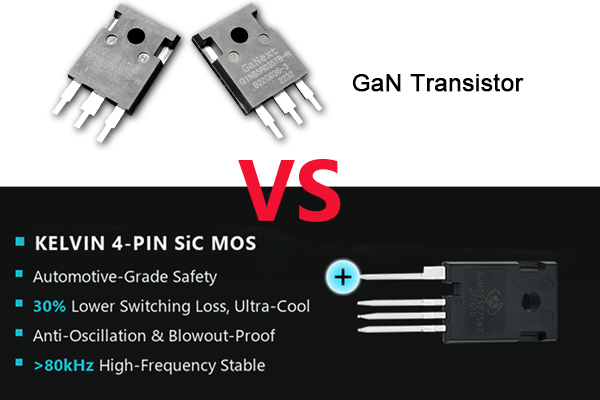 |
Fairly stated, GaN still has the edge on raw switching loss. But professional amplification needs the combination of voltage headroom, drive margin, thermal path and robustness — and that combination points to SiC. A tougher material is also what gave us the confidence to run the 4-pin package in the same move.
7. Two things shipped alongside
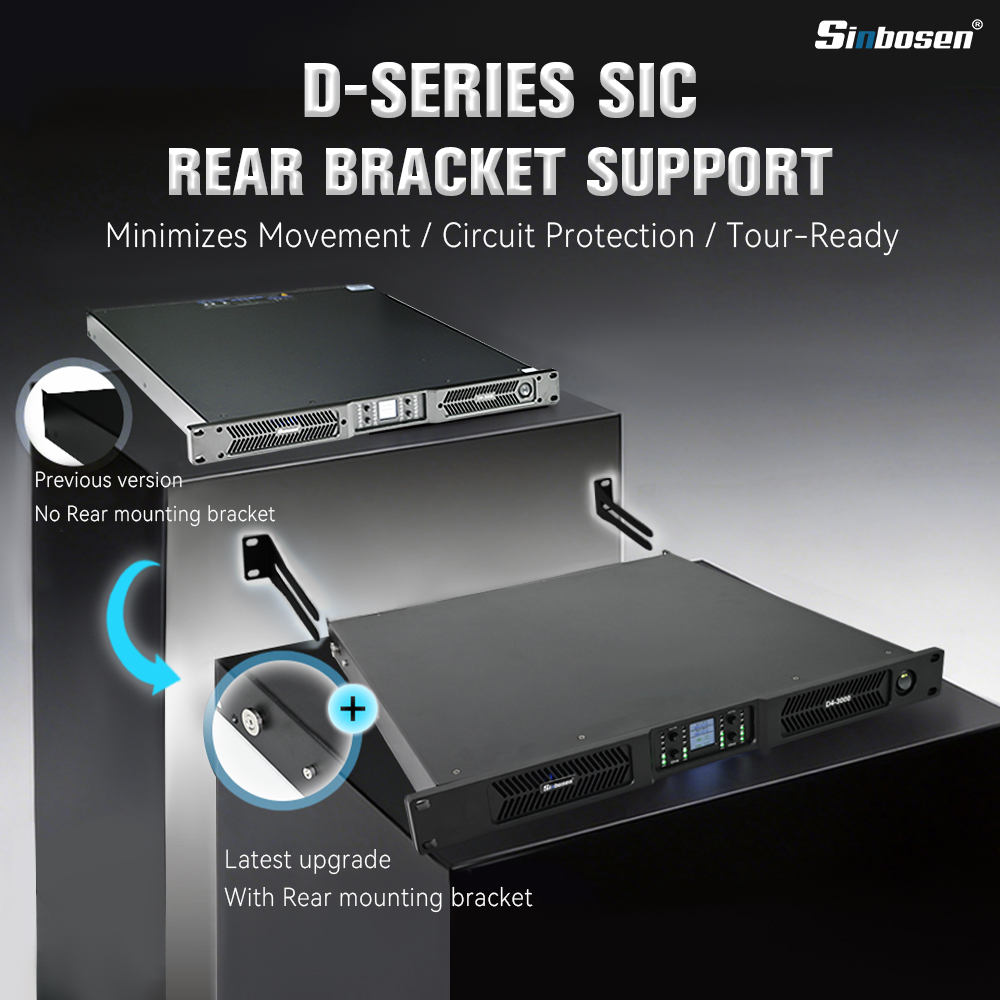
Rear brackets (FP / D / SR Series) — all three series now carry a rear bracket structure that sets them apart. Heavy amplifiers that are loaded in and out constantly behave very differently over time when the chassis is supported front and rear: more solid in the rack, safer in the case.
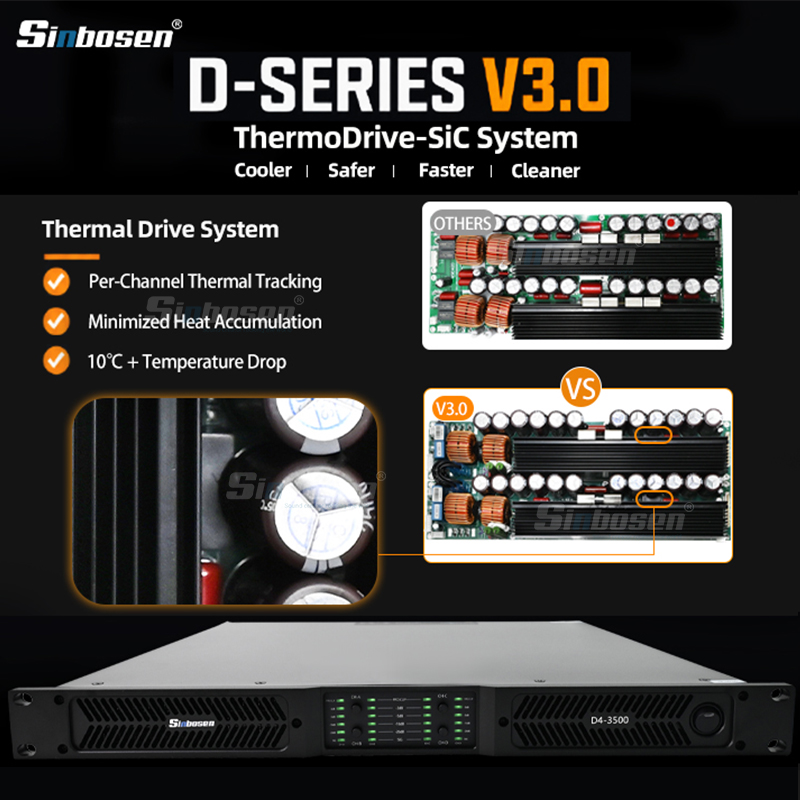
ThermoDrive-SiC (D Series Pro V3.0 / SR Series — not fitted on the STD version) — the STD version already runs cooler and steadier with the 4-pin SiC power stage; ThermoDrive is the thermal-side companion added on the Pro and SR Series, in three layers: the device generates less heat at the source; per-channel thermal tracking cools exactly where and as much as needed, without wasting the noise budget; tunnel airflow with low-speed, high-airflow fans minimises heat accumulation. Together they take a further 10°C+ off the system. Heat sets the fan speed, fan speed sets the noise floor, and the noise floor decides whether you can hear the breath in the take.
 |
 |
Contact us:
 sales2@sinbosen.com
Whatsapp:https://api.whatsapp.com/send?l=en&phnoe=8616676738225
Website:https://www.sinbosenaudio.com/

